Alerts

The Great Powers Converged on the Holy Land in the 19th Century

The Jews of Jerusalem flocked to receive the German Emperor in 1898.
Share this
Kaiser Wilhelm II with Kaiserin (Empress) Auguste Viktoria, 1898

Table of Contents

The end of the Crimean war in 1856 left the warring sides in a state of limbo. Russia was defeated, and heavy losses weakened Great Britain and France, and particularly Turkey. The Ottoman empire was fraying on all its fronts. One of the causes of the war was, ostensibly, religious practice in Jerusalem, then under Ottoman rule: Russia insisted on promoting the interests of Eastern Orthodox residents; France sought to protect Catholic residents. Protestant England was on the sidelines until economic considerations came into play.

The opening of the Suez Canal in 1869 and the introduction of steamships meant increased cargo and pilgrims in the eastern Mediterranean. The Canal facilitated commerce for Britain and its colonies in the far east. The larger number of visitors to Palestine led European countries, including Germany, to press Turkey to permit the opening of consulates, churches, hospitals, and other facilities for their citizens.

The Russian Compound in Jerusalem.
Russian “barracks” in Jerusalem for pilgrims, 1899
Russian “barracks” in Jerusalem for pilgrims, 1899 (Library of Congress)
The Austrian Hospice, Ratisbonne Monastery, Jerusalem
The Austrian Hospice, Ratisbonne Monastery, Jerusalem, was inaugurated by Emperor Franz Joseph in 1869. The emperor also funded the building of a dome on the Tiferet Yisrael Synagogue.

The four domes of Jerusalem circa 1865.
The four domes of Jerusalem circa 1865. 1. Al Aqsa Mosque. 2. Hurva Synagogue. 3. “Hatless” Tiferet Yisrael Synagogue, to which Emperor Franz Joseph donated funds for a dome. 4. Dome of the Rock. (Library of Congress)

The Eye Hospital of the Knights of St. John, 1895
The Eye Hospital of the Knights of St. John, 1895. The hospital opened in 1882 and was given a royal charter by Great Britain’s Queen Victoria. (University of Rochester, Eastman Museum)

A remarkable historic site, the Tomb of the Kings, was obtained by France in 1868. The burial chamber did not hold the bodies of Judean kings, but the elaborate sarcophagi found there suggested they once contained the remains of wealthy Jerusalem dignitaries. Despite the objections of Jerusalem’s Jewish community, the sarcophagi and remains were smuggled to the French Louvre, where they are now displayed.

German Emperor Wilhelm touring the Tombs of the Kings, Jerusalem, 1898
German Emperor Wilhelm touring the Tombs of the Kings, Jerusalem, 1898. (Library of Congress)
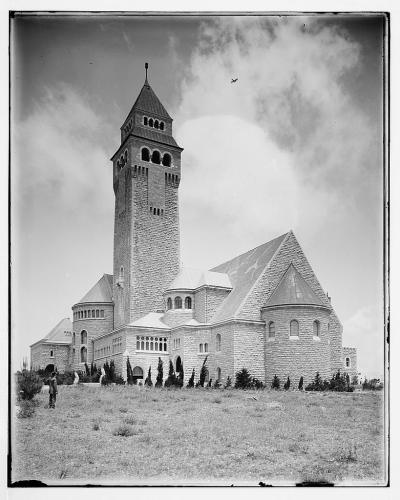
The Augusta Victoria hospital and German Protestant Church of the Ascension compound on the Mt. of Olives
The Augusta Victoria hospital and German Protestant Church of the Ascension compound on the Mt. of Olives, built by the German Emperor and Empress, circa 1915. (Library of Congress)

The Jews of Jerusalem Welcomed the German Emperor

In 1898, German Emperor Wilhelm and his wife Augusta Victoria visited the Holy Land. The historic visit was covered extensively by the world’s press.

The Jews of Jerusalem built a large pavilion on Jaffa Road in their honor. Waiting for the Emperor beneath were two chief rabbis, Torah scrolls, and ceremonial treasures from the synagogues of Jerusalem.

The Jewish community built the ceremonial arch in Jerusalem to welcome the Emperor of Germany
The Jewish community built the ceremonial arch in Jerusalem to welcome the Emperor of Germany. It was located on Jaffa Road in the area of today’s Clal Building. (1898, Library of Congress, American Colony Photographic Department)

The high-resolution photographs provide the ability to enlarge and examine details. The Jews bedecked the arch with Jewish ornamental treasures. They were dressed in their best finery (the day was Shabbat). The wall was covered by tapestries that typically covered Torah arks. The embroidery dedications on the tapestries are legible and reveal which synagogues donated their curtains. Sitting below were Sephardi Chief Rabbi Yaakov Shaul Elissar and Ashkenazi Chief Rabbi of Jerusalem Shmuel Salant.

Ashkenazi Chief Rabbi of Jerusalem Shmuel Salant
Ashkenazi Chief Rabbi awaited the emperor.
Sephardi Chief Rabbi Yaakov Shaul Elissar
Sephardi Chief Rabbi also awaited the emperor.

The banner sign welcoming the emperor was decorated with silver crowns and breastplates that usually rested on Torah scrolls.
An enlargement of the Holy Ark curtain
An enlargement of the Holy Ark curtain donated by Shlomo Zalman Tzoref, who was one of the builders of the Hurva Synagogue in Jerusalem’s Old City. In 1851, Tzoref was assassinated by an Arab swordsman. He is buried on the Mt. of Olives and is considered the first victim of Arab terrorism.

From the Istanbuli Synagogue
From the Bukharin Synagogue

Ultra-Orthodox Jews turned out, but not their rabbi, Chaim Yosef Sonnenfeld, who believed the German nation was the embodiment of Israel’s Biblical arch-enemy Amalek. He refused to recite a blessing upon seeing an Amalekite king.

Ultra-Orthodox Jews lined the German emperor’s route inside Jerusalem
Ultra-Orthodox Jews lined the German emperor’s route inside Jerusalem. They wore their best garb since the emperor arrived on the Sabbath. (Enlargement, Library of Congress)

At last, the emperor’s procession ended at the Old City’s Jaffa Gate, where a new entrance was excavated to allow the emperor’s carriage to enter. Outside the gate, a tremendous celebration occurred, but something was missing.

The German emperor arrives at the Jaffa Gate of the Old City
The German emperor arrives at the Jaffa Gate of the Old City. What’s amiss? (1898, Library of Congress)

Closed stall next to the Jaffa Gate

After enlarging the photo of the German emperor’s arrival, we can see that one stall – the one closest to Jaffa Gate – was closed. Why?

Jaffa Gate with carriages waiting outside, circa 1898
Jaffa Gate with carriages waiting outside, circa 1898. All the stalls were open.

Jewish hat store next to the Jaffa Gate

The booth in the prime location was a Jewish hat store, indicated by the sign and the customers outside. Of course, it would be closed on Shabbat, even if the emperor himself was just meters away.

Lenny Ben-David

Lenny Ben-David worked for AIPAC for 25 years in Washington and Jerusalem. In 1997, he left to open an independent consulting firm, but Prime Minister Benjamin Netanyahu tapped him to serve as Deputy Chief of Staff in Israel’s Washington Embassy. He is the author of the book American Interests in the Holy Land Revealed in Early Photographs, and he is completing his next book, Secrets of World War I in the Holy Land Revealed in Early Photographs. He is a Research and Diplomacy Fellow at the Jerusalem Center.
Share this

Invest in JCFA

Subscribe to Daily Alert

The Daily Alert – Israel news digest appears every Sunday, Tuesday, and Thursday.

Related Items

Stay Informed, Always

Get the latest news, insights, and updates directly in your inbox—be the first to know!

Subscribe to Jerusalem Issue Briefs
The Daily Alert – Israel news digest appears every Sunday, Tuesday, and Thursday.

Notifications

The Jerusalem Center
The Failures of French Diplomacy in Lebanon

Does Macron have such a short memory that he can forget the presence of Yasser Arafat and his terrorists in Beirut? Khomeini’s hateful propaganda in Neauphle-le-Château, near Paris?

12:07pm
The Jerusalem Center
This is How Hamas Opened a Front in Europe

Hamas and the Muslim Brotherhood identified Europe’s weak point. In a naivety mixed with stupidity, the continent’s leaders do not understand the principles of fundamentalist Islam – and we are paying the price for it. 

12:06pm
The Jerusalem Center
The Digital Panopticon: How Iran’s Central Bank Aims for Financial Legitimacy and Absolute State Control

The Digital Rial transitions the financial landscape from one where transactions can occasionally be tracked to one where they are always monitored, always recorded, and always subject to state intervention.

12:05pm
The Jerusalem Center
Why Saudi Crown Prince Mohammed bin Salman Is “Slow-Walking” Normalization With Israel

Trump seeks a historic achievement, but Riyadh is not willing to pay the price without a genuine settlement ensuring the establishment of an independent Palestinian state.

12:05pm
The Jerusalem Center
Between Hitler and Hamas: The Dangers of Appeasement and Genocidal Aggression
The past is never far away. The study of Hitler’s “whole method of political and military undermining” and today’s methods of Hamas raises an open question.
10:32am
The Jerusalem Center
Mamdani’s Triumph Is Likely to Embolden Leftists in the West
For European observers, in particular, the success of the Red-Green alliance in the New York City mayoral race should be a wake-up call.
 
10:31am
The Jerusalem Center
Christian Zionists: Civilization’s Defense Force in an Era of Existential Threat

The 700 million Christian Zionists worldwide constitute a force multiplier for Israel’s international security and diplomatic standing, and a powerful counterweight to delegitimization and defamation campaigns targeting the Jewish state.

10:30am
The Jerusalem Center
Tehran Under Pressure: Nuclear Escalation, Economic Strain, and a Deepening Crisis of Confidence

The Iranian leadership is struggling to stabilize its grip both internally and externally.

10:28am
The Jerusalem Center
The Black-Market Drain: How Illegal Crypto Mining Cripples Iran’s Electricity and Economy

The illegal crypto mining phenomenon in Iran is not merely a few isolated cases of law-breaking; it is an organized, large-scale black market enabled by highly subsidized energy prices.

10:26am
The Jerusalem Center
The Gaza Flotilla Is a Fraud

Far from a humanitarian mission, the latest 70-vessel spectacle on its way to Gaza from Italy is a costly act of political theater @FiammaNirenste1 @JNS_org

11:28am
The Jerusalem Center
The Assassination of Abu Obeida – Why Is Hamas Remaining Silent?

Senior Israeli security officials note that such silence is not new; Hamas often delays its statements following targeted Israeli assassinations, raising questions whether this stems from attempts to verify the information or from a deliberate strategy of ambiguity https://x.com/jerusalemcenter

11:25am
The Jerusalem Center
The Impact of Radical Legal Ideology: From the Classroom to the International Forum

Massive funding of Critical Legal Studies-style academic and extracurricular programs promotes anti-Western ideas and undermines international community institutions and legal conventions https://x.com/jerusalemcenter

11:23am

Close