

Summary
A revolutionary regime established decades ago elevated a historically marginalized religious community into a powerful ideological and political force across the Middle East. Over time, expansionist ambitions and reliance on militant networks strengthened its influence but also created vulnerabilities. Strategic errors, international pressure, and internal power struggles are now exposing cracks in the system and raising uncertainty about future leadership. Increasing unrest, potential military fractures, and rising minority movements could push the state toward a period of severe instability.
Key Takeaways
- A revolutionary religious state transformed Shiite identity from a marginalized minority into a political and ideological force that reshaped regional dynamics.
- Strategic miscalculations, international pressure, and internal structural weaknesses are creating growing instability within the ruling system.
- Power struggles, possible succession disputes, and the dominance of a powerful military elite could accelerate fragmentation, unrest, and challenges from regional minorities.
Since seizing control of Iran nearly five decades ago, the Islamic Revolutionary Guard Corp (IRGC) built something rare in history, a religious political project that managed to reshape the Middle East. The revolution of 1979 was not merely a change of regime. It was a cultural earthquake. For centuries the Shiites had been a persecuted minority, scattered like dust among mountains and cities, no more than a fifth of the population in the Sunni sea around them. Suddenly a state arose that gave them a name, a face, and a voice. From Tehran came the message: Shiism is no longer a victimized sect swimming under blows. It is a source of power, the beating heart of a global revolution.
For years it seemed that the engine of the revolution was only growing stronger. The revolution extended its arms across the world, South America, Lebanon, Iraq, Yemen, Sudan. Even when parts of it creaked, even when smoke rose from within it, it kept moving. But engines that ignore warning lights do not run forever.
Now the wheels are beginning to jam. A series of colossal mistakes, a misreading of the American administration, an underestimation of the international community, dependence on treacherous patrons, Russia and China, has led the Iranian leadership to the edge of the abyss. What was built over decades as a palace of revolutionary self-confidence now begins to look like a magnificent building whose foundations are slowly sinking into the sand.
And precisely in moments like these, when a player realizes the game is over, true character emerges. The conduct of Iran and its proxies, firing at neighboring states and widening the fronts of war, is not an expression of strength. It resembles a chess player who, in rage, knocks the pieces off the board as checkmate approaches: noise, chaos, and no purpose.
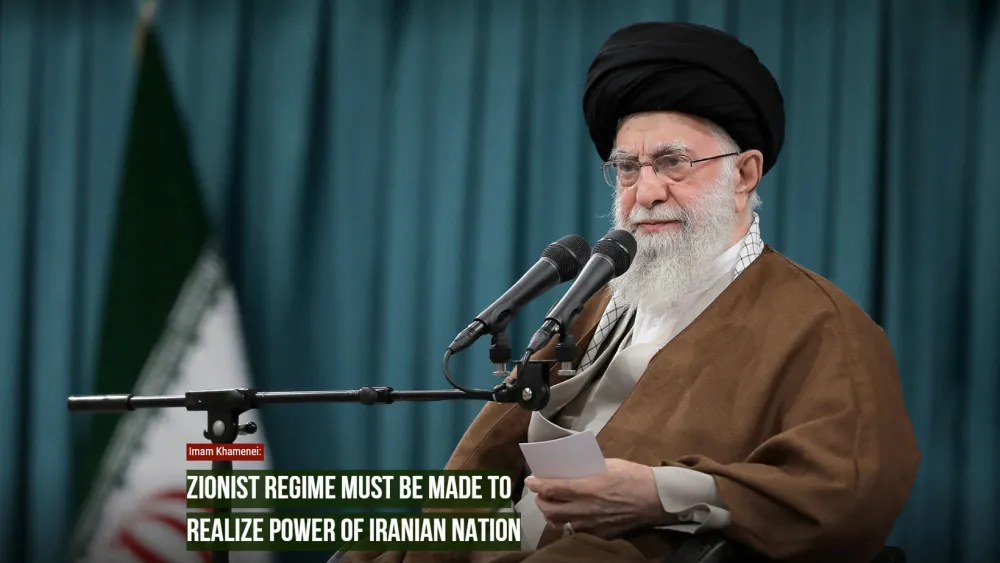
Into these cracks enters the question of succession. The name that arises again and again is Mojtaba Khamenei, the son of the Supreme Leader. Yet Mojtaba is not a leader who grew out of the religious tradition. He has no religious law backbone, no aura of a learned cleric, and no real military experience to his credit. If appointed, he will be a chair without legs, a figure who holds the title but is held by the Revolutionary Guards. Not a leader who guides the system, but a puppet the system places on a pedestal.
Alongside him also hovers the shadow of another possible appointment, Ahmad Vahidi, former defense minister, a senior commander in the Guards, and internationally wanted for his involvement in the 1994 bombing of the Jewish community center in Buenos Aires. His name is a quiet reminder of the character of the security elite that believes it will run the state: people raised in a culture in which violence is not a failure of policy but an operational instrument.
In practice, it has long been clear who runs the country. The Revolutionary Guards are not merely an army; they are an empire. Economically and ideologically, in their view the current campaign is one battle: the battle of Karbala, repeating itself in every generation. The historic battle in which the blood of Husayn ibn Ali was shed has become the lens through which they read reality. Every confrontation is a new chapter in the eternal drama of a faithful minority against a hostile world, and therefore every compromise feels like betrayal.
This logic also explains the pressure placed on Hizbullah. The Revolutionary Guards made it clear to the organization in Lebanon: if you do not join now, the relationship ends. Hizbullah found itself between a rock and a hard place. Refusal would sever it from its patron in Tehran, from money, weapons, and ideology, and its fate as a revolutionary religious organization would be sealed. Yet entering the confrontation could ignite a fire in Lebanon, including among Shiites who no longer burn with the revolution. Hizbullah’s choice effectively sealed its fate.
What exactly is the strategy of the Revolutionary Guards? They believe in a scenario of delayed redemption: it is enough to inflict casualties on the Americans, close the straits, and attack the oil states. Oil prices will jump, and public opinion in the United States will force Trump to end the conflict. Yet here too they may be reading from an old map. Instead of an American withdrawal, the pressure may converge inward and become a tightening ring around the neck of the regime itself.
Another week of confrontation could begin to unravel the seams. Desertions in the regular army, erosion within the Revolutionary Guards, these are no longer theoretical scenarios. Parts of the military may become “lights out”: not rebellion, but simply a presence that fades away.
Into that vacuum the minorities will likely enter: Kurds in the northwest, Baloch in the southeast, Ahwazis and others. When the heart stops sending blood, the limbs begin to move according to their own laws. And if the masses take to the streets, as they already have, again and again, in waves of protest that grew each time, Iran will be swept into a storm with no sovereign.
Thus the revolution of 1979 may reach its final hour. What was built as a fortress will be revealed as a glass palace, impressive from the outside, fragile at a touch.
And then an ancient proverb the Persians knew long before Islam settled in their land will prove true again:
“The candle that presents itself as the sun burns out first.”