


On November 17, 2020, the Palestinian Authority announced it would restore security cooperation with Israel and agreed to receive tax monies Israel had collected for them.
But for the near future, the prospects for the Palestinian Authority (PA) stay gloomy. The Arab Spring changed priorities in the Middle East. Observers must be careful to avoid the common mistake of judging the prospects for the PA through the two-sided view of the Israeli-Palestinian conflict, while the truer, wider assessment should be regional. The Palestinians must make decisions with their eyes focused on their natural milieu – the Arab Sunni world – and not Turkey, Iran, or the Shia world, in general. In this new reality, the Sunni Arabs find themselves siding with Israel and not with the Palestinians.
What makes things even worse for the PA’s leader Mahmoud Abbas: the Israeli-Arab Sunni alliance is attracting European powers such as France because of the Turkish-French tensions in the Mediterranean and the war by their proxies in Libya. President-elect Biden cannot ignore these real facts on the ground and dismiss them. What he can do is convince the PA and Israel to return to the negotiation table, not to challenge the Israeli-Arab Sunni alliance, but to add the PA to it.
The PA’s hesitation in this regard is that of losing Turkey and Iran as diplomatic cards to use and being compelled to rely on Qatar to balance the Gulf States and Saudi Arabia. During the Trump term, this was not possible. In the Biden presidency, the PA hopes it can keep the Sunni world while placing Turkey and Qatar on the side without losing them. This is especially important to Mahmoud Abbas because of the challenge of political rival Mohammed Dahlan who lives in the United Arab Emirates. Relying only on the Gulf with no other cards to play means strengthening Dahlan’s loyalists on the West Bank and the Palestinian diaspora.
Abbas’ shuffling of cards with the fake reconciliation talks in Turkey led by the Qatari proxies Jibril Rajoub (Fatah) and Salah Aruri (Hamas) was considered anti-Trump. In the Arab Sunni world, however, the maneuver was deemed to be dangerous.
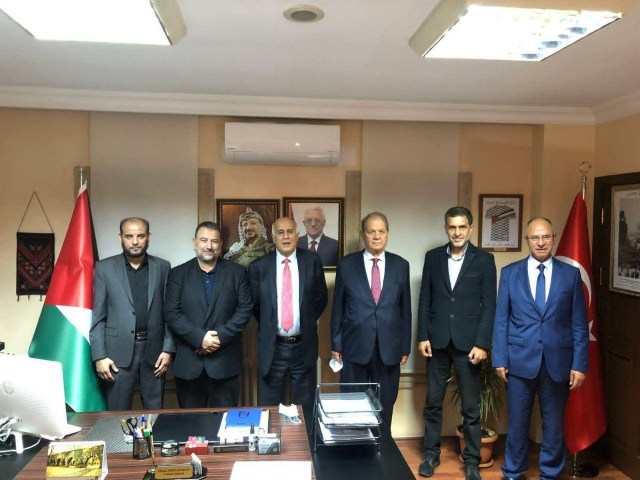
Fatah-Hamas Cooperation Lit Arab Warning Lights
The first Arab state alarmed by the Fatah-Hamas talks was Jordan. The very prospect of Hamas gaining power in the West Bank is a horror for the Hashemite Kingdom. Although the Moslem Brotherhood, of which Hamas is a subsidiary, is a legitimate power in Jordan – as a political party – Hamas is seen as the dangerous armed wing of Moslem Brotherhood.

According to Palestinian sources, Jordan recently exploited the visit of a senior American figure who has open doors to both Trump and Biden to convince Mahmoud Abbas to draw back from his Hamas track and return to the negotiating table with Israel. The American promised to work with Biden, once elected, to renew the talks with Israel. Apparently, Jordan also applied its diplomacy in Washington in this regard.
During the fake talks between Fatah’s Rajoub and Hamas’ Aruri in Turkey, Mahmoud Abbas considered giving his approval to elections with a joint Hamas-Fatah list, but not actually implement elections, in order to bring fresh relevance to the long-forgotten and by-passed “Palestinian problem.”
Negotiations on the PLO’s Terms
On November 17, 2020, the PA announced it would restore PA-Israel security cooperation, accept $100 million a month in tax money collected for them by Israel, and restore salaries to public workers. With that, Abbas is signaling to the Biden administration his readiness to return to the negotiations – but on the PLO’s terms. That includes restoration of American aid, a repeal of Trump’s policies on Jerusalem and the U.S. Embassy, 1967 boundaries, and a solution for Palestinian refugees.
Those maximalist negotiating points do not fit the new mood of the Arab Sunni countries that prefer the “deal” approach and a compromise on borders in the West Bank instead of the PLO’s myth of a “popular struggle” – even as a “political struggle.” These Sunni countries acquiesced to the Trump moves regarding Jerusalem, but the issue of Jerusalem is very sensitive in inter-Arab-Muslim struggles and deserves a separate examination.
An issue that concerns the Arab Sunni powers is the re-focus on human rights issues that Biden, like Obama, almost surely will adopt. Worried Saudi and Egyptian voices are already being heard.
The news that President Trump lost the elections was received in Ramallah with relief, not so much because of political prospects of renewing the peace talks, but because the Trump plan had annulled the PLO doctrine of the liberation of Palestine by “struggle” – military or political. The path of “struggle” led the Palestinians to a deadlock; the path of a “deal” led to the normalization peace treaties between Israel and the Gulf States. Today, the term “peace” is associated with the Gulf and not with Palestine, and the incentive of Western leaders to invest in the Palestinian problem to win their Nobel prizes is dramatically reduced.


